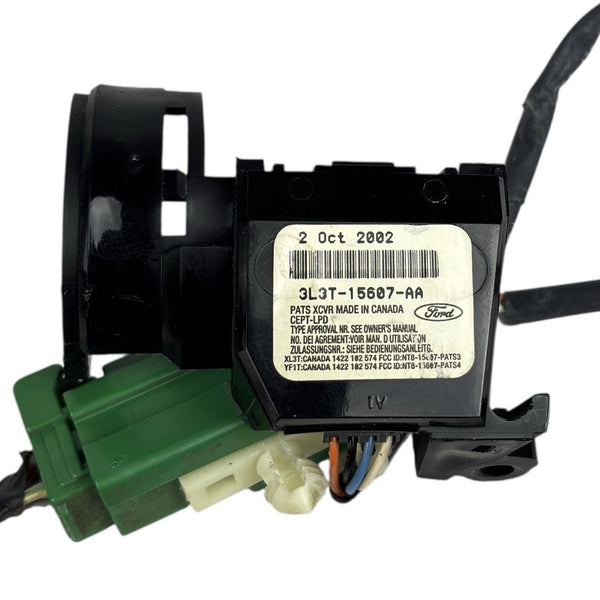
Ford PATS: Which Swaps Need Programming and Which Don't


On a keyed Ford with PATS, a replacement transceiver ring plugs in and works with the keys you already have, with no programming. The ring only reads the key; the key codes live in the PCM or the instrument cluster, depending on the vehicle. Programming comes in when you add a key, lose your keys, or replace the module holding those codes.
What each part of PATS does
PATS is the Passive Anti-Theft System, Ford's factory immobilizer. Ford also calls it SecuriLock in the owner's guides. Three pieces matter when you're deciding what a swap will cost you:
- The key. A coded chip in the key head. It has no battery of its own.
- The transceiver ring. The ring around the ignition lock, Ford part number family 15607. It reads the chip and passes the answer along. That's its whole job.
- The module holding the codes. Depending on the Ford, that's the PCM (the engine computer), the instrument cluster, or on some older cars a separate PATS control. This is the part that decides whether your key is allowed to start the engine.
Once you know the ring is only a reader, the rest of this page follows from it. If your Ford has push-button start, this page isn't about your car.
Which swaps plug in and which need programming
| What you're replacing | Programming? | Who does it, and what you need |
|---|---|---|
| Transceiver ring | No. Your keys keep working. | You, or any shop. You need the same part number as the ring you took off. |
| Adding a spare key | Yes, on the key | You, on many Fords, with two working coded keys and a new key cut for your locks. Otherwise a dealer or a locksmith set up for Ford. |
| All keys lost, or none coded | Yes, on every key | A dealer or a locksmith set up for Ford. The car goes to them, or they come to it. Plan on at least two new keys. |
| PCM | Yes. Expect a no-start until it's done | A shop with a Ford-level scan tool, or a dealer. Bring every key you own. |
| Instrument cluster, on a Ford that keeps its keys in the cluster | Yes. Parameter reset, and the keys programmed in again | A shop with a Ford-level scan tool, or a dealer. Bring every key you own. |
Ford's own procedure says it plainly for the ring. The service instructions for the 2007 Explorer, the 2008 Super Duty and the 2009 E-Series all state that replacing the transceiver does not require the keys to be programmed again. A technician who did the job on a 2004 Explorer reports the same result: the PCM held the key codes, the ring was "simply the sensor," and no relearn was needed.
The PCM and cluster rows are the opposite case. A replaced PCM may crank and even fire, then die almost immediately until the relearn is done. On a Ford that keeps its keys in the cluster, the 2014 Mustang workshop manual says the parameters have to be reset in both the cluster and the PCM, or you get a PATS no-start. Neither of those is a bad part. For the same question across BCMs and clusters on other makes, see Do BCMs, Clusters & Immobilizers Need Programming?
Make sure it's the ring before you buy one
A ring fixes a ring problem and nothing else. Work through this first. The symptom side is covered in more depth in How to Tell If Your Ford PATS Anti-Theft System Is Failing.
- Watch the theft light with the key on. Ford's owner's guide says a light that flashes rapidly or stays on steady at key-on means a problem. Most PATS no-starts still crank. Some Fords cut the starter too, so a no-crank doesn't clear PATS on its own.
- Take every other key off the ring and try again. Both Ford's owner's guide and its service bulletin warn that a second coded key or metal on the chain can interfere with the read. It's free to check, so check it first.
- Try your spare. If one key starts it and the other doesn't, the key is your problem. If neither one does, or both work only some of the time, look at the ring and its wiring.
- Scan with a tool that reads PATS. A basic engine-code reader may only show you P1260, which Ford's PATS bulletin says is a direction to go read the PATS codes. That bulletin covers 1996-2000, and codes can differ on later Fords.
- B1601 is an unprogrammed key. The bulletin says no parts should need replacing. Program the key.
- B1600 or B1602 means no key read, or only part of one. Key or ring, and B1600 can also be the wiring or the module.
- B1681 means the ring's signal isn't reaching the module. Ring, wiring, or possibly the module.
- U1147 is a communication problem between the PCM and PATS. The bulletin says the key and the ring cannot cause it, so don't buy a ring for this one.
Match the number stamped on your ring
"No programming" only holds if the ring is the right one, and Ford changed this part many times by model and year. Pull yours and read the stamped number. These are the part numbers we list and what each one fits:
| Stamped number | Fits |
|---|---|
| F6ZF-15607-BA | 1996-1997 Mustang |
| F8ZB-15607-AB | 1998 Mustang built before 3/25/98 |
| XL3T-15607-AD | 1999-2000 F-150, Expedition, Navigator; 1999 F-250 light duty, Taurus, Sable |
| 1L3T-15607-AB | 1999-2002 F-150, Expedition, Navigator; 1999 F-250 light duty, Taurus, Sable |
| 3L3T-15607-AA | 2003 F-150; 2004 F-150 Heritage (not the redesigned 2004 F-150) |
| 98VP-15607-AB | 2000-2005 Focus; 2001-2004 Escape; 2000-2002 Lincoln LS; 2002-2003 Thunderbird |
| 1F1T-15607-AA | 2000-2002 Taurus, Sable; 2001-2002 Windstar |
| 3F1T-15607-AB | 2003-2007 Taurus; 2003-2005 Sable; 2003 Windstar; 2004-2007 Freestar, Monterey |
| 2S6T-15607-BC | 2005-2008 Mustang, Crown Victoria, Grand Marquis, Town Car; 2005-2007 Five Hundred, Freestyle, Montego |
Each product page shows whether it's on the shelf today, and the rest are in our immobilizers collection. If your stamped number isn't here, message me with it before you order. Our guide to finding the right part number explains how Ford's numbers work. Our rings are used OEM parts, tested for functionality where applicable, with a 30-day money-back guarantee.
What to tell your shop
A shop can only rule things out if it knows what's already been changed. Before the appointment, have these ready:
- Which part you replaced, and the number stamped on the old one.
- How many working keys you have. Bring all of them. Most Fords need at least two programmed keys, and a shop can't count one that's sitting at home.
- The codes you pulled, and which tool you pulled them with.
- Whether the car started on either key before the swap.
If all you replaced is the ring and it still won't start, say so. That points the shop at the key, the wiring or the module holding the codes, and not at programming the ring.
Frequently asked questions
Does a used Ford PATS transceiver need programming?
No. The ring only reads the key. Your key codes stay in the PCM or the cluster, so your existing keys keep working with a replacement ring that matches the original part number.
Will a used ring remember the keys from the car it came off?
No. It isn't a programmable part and doesn't hold key codes, so nothing from the donor car carries over.
Can I replace the PATS ring myself?
Usually, if you're comfortable under the column. On a 2008 Super Duty, Ford's procedure is the lower steering column shroud, one connector and two tabs. Other models differ, so check the procedure for yours.
Can I program a new Ford key myself?
On many Fords, yes, if you already have two coded keys and the new key is cut for your locks. Your owner's guide has the steps. With fewer than two, it's a dealer or a locksmith set up for Ford.
Why won't my Ford start after I replaced the PCM?
The new PCM doesn't know your keys or your car's security setup yet. It can crank and even fire, then die. It needs a PATS relearn with a Ford-level scan tool. That isn't a bad PCM.
— Hubes
Written by
Chris Huber, Owner — Hubes Hub
30 years in OEM auto parts — most of it spent in Michigan. At Hubes Hub I source, test, and ship every OEM part that leaves the shop — and I answer the inbox. If you're working through a tough repair and aren't sure which part you need, message me before you order.
More about the shop →