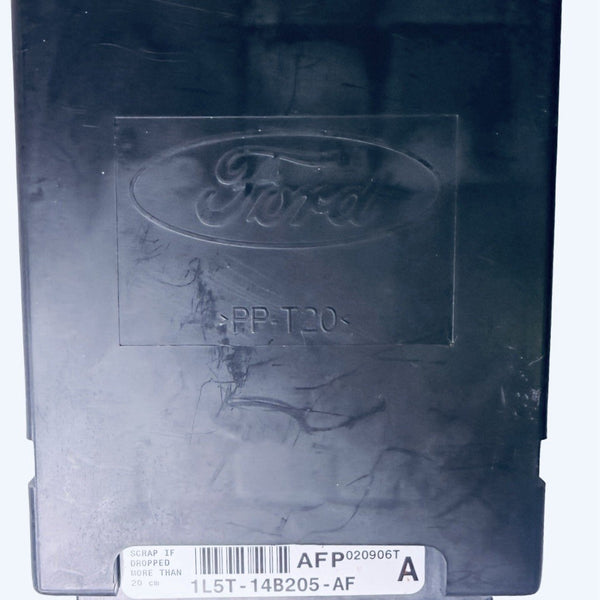
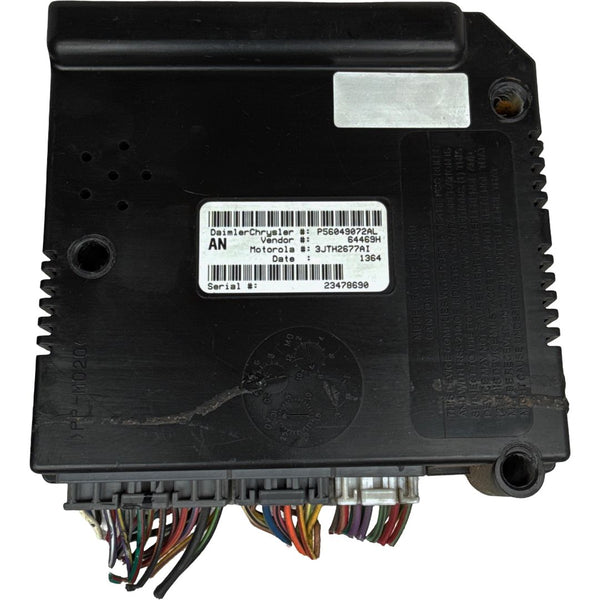
Finding the Right Part Number: OEM, MPN & Interchange


The number stamped on your old part is the most reliable thing you own when buying a replacement — more reliable than year, make and model. But most parts carry several numbers, and they don't all mean the same thing. Here's how to read them, which one to match, and where the usual "the letters don't matter" advice will get you the wrong part.
The three numbers, and which one matters
Pick up almost any electronic module and you'll find more than one number on the label. They serve different purposes:
-
The OEM part number — the manufacturer's own number for that
component. This is the one you match. On a Ford module it looks like
YL34-14B205-CA; on a Mopar part,56045448AD; on GM, an eight-digit number like25869946. - The MPN — manufacturer part number as listed by whoever is selling it. For a genuine OEM part it's usually the same number. On aftermarket parts it's the aftermarket maker's number, which will not match your original at all.
- The seller's SKU — an internal stock number. It identifies a listing in one seller's system and means nothing to your vehicle. Never match on it.
There's also the interchange number — used-parts catalogs group parts that swap for each other into interchange sets. That's a useful net for finding candidates, but it's a starting point for a search, not proof a part fits yours.
How to read a Ford part number
Ford numbers are three pieces: a prefix, a basic number, and a suffix.
Take YL34-14B205-CA:
-
YL34— the prefix. The first character is the design year, the rest identifies the product line and the engineering office that released it. -
14B205— the basic number. This says what the part is. Every Generic Electronic Module across a decade of Fords shares14B205. -
CA— the suffix. This says which version. Suffixes start at A and advance as changes are made.
The first character is worth learning, because it dates the part at a glance. Ford used
decade letters into the 1990s — F for the 1990s, so F7 is 1997
— then moved to a worldwide scheme in 1998: X = 1999,
Y = 2000, then 1, 2, 3, 4 for
2001 through 2004, and on from there.
One caveat that trips people up: that's the design year, not the model year. A part designed in 2012 routinely shows up on 2013 and later vehicles. Use the prefix to place a part in time, not to confirm it fits.
How to read a Mopar or GM number
Mopar numbers are eight digits followed by two letters —
56045448AD. The letters are the revision level. AA is the original
release, and it advances to AB, AC and so on as the part is updated.
For a new part over the counter, the highest letter is the current one and supersedes
the earlier revisions.
GM uses a plain eight-digit number with no suffix —
25869946. There's less to decode, which means there's less warning when two
similar-looking numbers are actually different parts. Match it exactly.
Where "the letters don't matter" goes wrong
The common advice is that suffix letters are just revisions, so any letter will do. For new service parts, that's mostly fair. For used electronic modules it is the single most expensive assumption a buyer makes, because manufacturers also use those letters to encode configuration — drivetrain, options, frequency, calibration. Same base number, genuinely different part.
Cases we've had to work out on our own bench, and now treat as rules:
- Ford GEM modules. On the F-150 line the suffix's first letter tracks configuration — 4x2 versus 4x4 — and the second is the revision. But that letter map is specific to that platform. On the Explorer and Ranger lines the same letters mean different things by generation, so we match against attested interchange sets for the exact part rather than doing letter arithmetic.
-
Chrysler timer modules. The Durango and Dakota family interchanges
fairly freely across suffixes. The Dodge RAM
56045448does not — it has to match exactly, because keyless and heated-seat options and build-date hardware splits sit behind it. - Immobilizers. SKIM and SKREEM are not the same module, and 315 MHz and 433 MHz units are not interchangeable. Module type and frequency both have to match.
- Ford CCRM. The calibration is engine-specific — a V6 suffix will not do on a V8.
- GM transfer case modules. Within one transfer-case family the numbers supersede cleanly because the module is reflashed to the VIN. Across calibration groups — push-button versus automatic — they don't, even when the connector matches.
The general test we apply before treating two numbers as the same part: would a buyer with the same vehicle be equally happy receiving either one? If color, completeness, calibration, configuration or fitment would make one of them wrong for them, they're different parts, however similar the numbers look.
What to do before you order
- Get the part out and read the label. Photograph it. Numbers are moulded or printed on a sticker that fades — a photo beats a number you retyped from memory.
- Match the basic number first. That confirms you're looking at the right kind of part at all.
- Then treat the prefix and suffix as configuration until proven otherwise. A different suffix might be a harmless revision. It might be a 4x4 module for your 4x2. Assume the second until something authoritative says the first.
- Note your options. Drivetrain, single or dual zone climate, heated seats, keyless entry, tow package, trim level. These are what the suffix letters usually encode.
- Ask. Send the number and your vehicle details. Any seller worth buying from would rather answer than take a return.
Why this matters more on used parts
A dealer selling new parts works from a catalog that resolves supersession for them — you give a VIN, it gives the current number. Used parts don't come with that. What you get is a physical unit with a number on it, and the burden of matching sits with whoever is listing it.
That's why we list the exact number off the label rather than the current superseded number that "should" cross over, and why we hold interchange claims to a reciprocal check — both numbers listing each other — before we treat two parts as one. A one-way interchange claim is a lead, not a fact.
If you're weighing OEM against aftermarket in the first place, we covered that in OEM vs Aftermarket Auto Parts, and the wider used-buying checklist is in How to Buy Used Auto Parts. If your part is a module that also needs configuring once it's in, see Do BCMs, Clusters & Immobilizers Need Programming? When you have your number, you can search it directly against everything we have in stock.
Frequently asked questions
What's the difference between an OEM part number and an MPN?
The OEM part number is the vehicle manufacturer's own number for the component, printed on the
part. MPN is whatever number the seller lists as the manufacturer part number — the same
number for a genuine OEM part, but the aftermarket maker's own number on an aftermarket part.
Match the number on your old part.
Do the letters at the end of a part number matter?
Often yes. On new service parts the trailing letters are usually revision levels and the latest
supersedes the rest. On used electronic modules those same letters frequently encode
configuration — drivetrain, options, frequency, calibration — so a different letter
can be a genuinely different part.
How do I decode a Ford part number?
Read it in three pieces: prefix, basic number, suffix. In YL34-14B205-CA,
14B205 is what the part is, YL34 identifies design year and product
line, and CA is the version. The first character dates it — F
for the 1990s under the old scheme, then X = 1999, Y = 2000,
1 = 2001 and onward.
What does AA or AB mean on a Mopar part number?
They're revision levels. AA is the original release and it advances to
AB, AC and so on as the part is updated, with the newer revision
superseding the older for new parts.
What is an interchange number?
It's a used-parts catalog grouping for components that swap for each other. It's a good way
to find candidates, but it doesn't by itself prove a specific unit fits your vehicle —
confirm against the part number and your options.
Can I just match year, make and model?
For a lot of mechanical parts, yes. For electronic modules, no — two of the same truck,
same year, with different option packages regularly take different modules. Match the number.
What if my part number doesn't appear anywhere?
Send it over with your vehicle details. Numbers get superseded, and some parts were only ever
listed under a number that no longer appears in current catalogs.
— Hubes
Written by
Chris Huber, Owner — Hubes Hub
30 years in OEM auto parts — most of it spent in Michigan. At Hubes Hub I source, test, and ship every OEM part that leaves the shop — and I answer the inbox. If you're working through a tough repair and aren't sure which part you need, message me before you order.
More about the shop →