Speedometer Dead? Diagnosing a Failing Instrument Cluster


If your speedometer drops to zero while you're moving, your gauges stick or read wrong, the needles sweep on their own, or the dash backlight goes dim or dark, the problem is usually the instrument cluster itself — the gauge panel behind the steering wheel — not the sensors feeding it. The clearest tell: a scan tool reads the correct data (say, 55 mph) while the needle says something different. A tested OEM cluster is the dependable fix, but on many late-model vehicles it has to be programmed to your VIN and mileage, so it's worth knowing what you're dealing with before you buy.
How a Failing Cluster Shows Up
The instrument cluster is the panel of gauges and warning lights directly in front of the driver. When it starts to go, the symptoms are usually electrical and intermittent rather than a clean, all-at-once death. The common ones:
- Speedometer or tachometer drops to zero or reads obviously wrong while you're driving.
- Needles stick, flutter, or sweep on their own — a gauge that hangs in one spot, or jumps around with no relation to what the car is actually doing.
- Fuel or temperature gauge reads full, empty, or pegged regardless of the real level.
- The display goes dim or dark — backlight or segment failure — while the gauges themselves may still work.
- Warning lights stay on, flicker, or the whole cluster resets as you drive.
- The odometer or trip display blanks out or shows garbage characters.
One gauge acting up points at the cluster. Several at once — especially with flicker or resets — points there even harder, because a single bad sensor can't make the fuel gauge and the speedometer fail together.
Why Instrument Clusters Fail
Clusters rarely fail from one dramatic event. They wear out from years of heat cycling and vibration. The failure modes, in rough order of how often they turn up:
- Stepper-motor failure. Each needle is driven by a tiny stepper motor — a small geared electric motor that moves the needle in precise steps. Worn internal gears, or more often a cracked solder joint where the motor meets the circuit board, make the needle stick, read low, peg out, or sweep. This is the classic "speedometer reads wrong" failure.
- Cracked solder joints. Years of expanding and contracting fatigue the solder on the board, especially at the motor pins and ground points. It's the single most common hardware fault, and it's why a cluster can act up cold and clear up once it warms (or the reverse).
- Capacitor aging. The capacitors in the power-supply circuit dry out over time, causing unstable voltage — random resets, flicker, and a dim display.
- Backlight or LED failure. A dim or dark display while the gauges still move is usually the lighting, not the gauges.
This isn't a fringe problem. The best-documented example is GM's full-size trucks and SUVs from the mid-2000s, where sticking and inoperative gauges were common enough to produce a 2008 class-action settlement and an extended GM coverage program for the repair. Those specific trucks aren't what we stock — but the same stepper-motor and solder failures show up across makes, which is exactly why a used cluster has to be tested before it's worth selling. Water intrusion can also corrode a cluster's connector, but that's a secondary cause, usually tied to a specific leak.
How to Diagnose It Before You Buy
Before replacing anything, confirm it's actually the cluster. A sound diagnosis runs in this order:
- Check the battery and grounds first. Low or unstable voltage and a bad cluster ground will mimic a failing cluster and can even set communication codes. Rule out the cheap stuff before you condemn the expensive part.
- Scan for communication codes. The cluster is a node on the vehicle's data network. If it stops talking, other modules log U0155 — "Lost Communication With Instrument Panel Cluster (IPC) Control Module." Related codes such as U0100 (lost communication with the engine computer) and U0140 (with the body control module) usually point at network or power problems rather than the cluster itself.
- Compare the scan data to the needle. This is the test that nails it. Watch live data on a scan tool: if it shows 55 mph while the speedometer needle sits at zero, the sensor and the network are fine and the cluster is lying. That data-versus-needle mismatch is the signature of a stepper-motor or board fault — and it usually sets no trouble code at all, because nothing reports the needle's real position back to the computer.
- Run the cluster self-test if the vehicle has one. At key-on, the warning lights do a brief bulb check — that part is normal. Many clusters also have a hidden self-test, entered with a button-and-ignition sequence, that sweeps every needle and lights every segment so you can spot a dead gauge or display. Just don't assume every car sweeps its needles on a normal startup — most don't.
Why a Tested OEM Cluster, and What Programming Means
A cluster is one of the parts where a cheap gamble bites hardest, for two reasons.
First, condition you can't see. The failures above — solder cracks, tired capacitors, worn stepper motors — don't show up in a photo. A unit that powers on at a bench can still drop a gauge a week later. That's the whole point of buying a tested OEM cluster: it's been verified working, not just pulled and wiped down.
Second, programming. On many late-model vehicles the cluster stores the odometer reading and is electronically married to the anti-theft system — the same immobilizer chain that decides whether the engine is allowed to start. So a replacement often has to be programmed to your VIN, with the mileage set to match the vehicle, at a dealer or a shop with the right OEM tool. Federal odometer law requires the displayed mileage to reflect the vehicle's true mileage, so that step isn't optional. Some older clusters that store mileage on the unit itself can be swapped without programming — which is exactly why a donor cluster's stored mileage matters when you source one. Ask before you buy whether a given cluster is plug-and-play or needs programming for your vehicle.
What We Stock
Cluster fitment is vehicle-specific: the part number has to match your year, make, model, and often the trim and options. These are the instrument clusters we carry. Stock on used parts changes week to week, so each listing shows whether it's in stock today. If one is sold out, use Notify me when available on its page: those requests tell us which clusters to pull next.
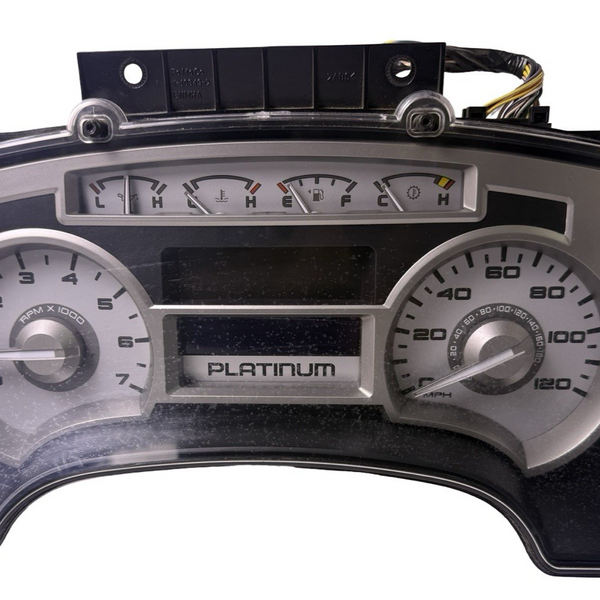
- 2010 Ford F-150 Platinum — OEM AL3410849BPA
- 2004–2005 Ford Explorer Sport Trac — OEM 4L3Z-10849-AA
- 2007 Ford Explorer Sport Trac — OEM 7A2T10849EE
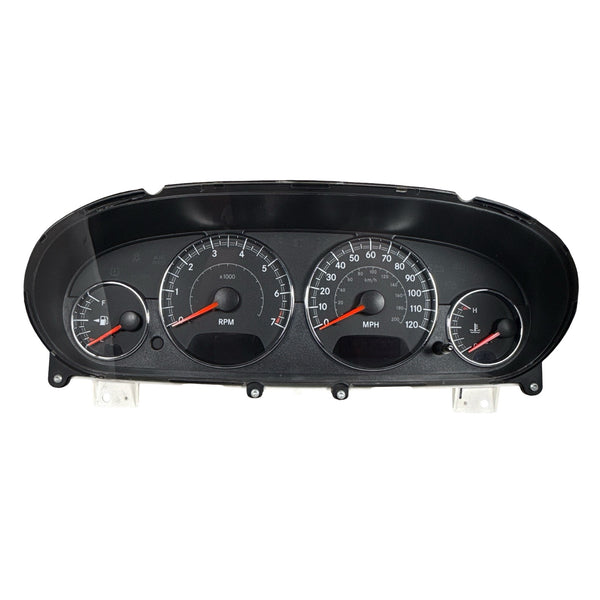
- 2004–2006 Chrysler Sebring / Dodge Stratus — OEM P04602472AA
Every one is a genuine OEM unit, tested before it ships. The full, current list is in the instrument cluster collection. If you don't see your vehicle, message us: we pull new clusters every week.
Frequently Asked Questions
Can a bad instrument cluster keep my car from starting?
Indirectly, on many vehicles, yes. The cluster is often part of the immobilizer chain, so if a replacement isn't programmed and married to the anti-theft system, the engine may crank but never fire. The gauges failing on their own usually won't stop a running car — but an unprogrammed replacement can keep it from starting.
Why does my speedometer read wrong but there's no check-engine light?
Because a stuck or miscalibrated needle is a mechanical fault inside the cluster, and nothing reports the needle's actual position to the computer. The sensor data is correct; the gauge just isn't displaying it. Confirm it by comparing a scan tool's live speed to the needle — a mismatch means the cluster.
Do I have to program a used instrument cluster?
Often, on late-model vehicles. Many clusters store the odometer and are tied to the anti-theft system, so a replacement has to be set to your VIN and true mileage at a dealer or a shop with the OEM tool. Some older clusters can be swapped without programming. Ask about your specific vehicle before buying.
Is an aftermarket cluster as good as OEM?
For most vehicles there's no real aftermarket equivalent — a cluster is a vehicle-specific electronic module, not a universal part. The realistic choices are a repaired original or a tested OEM unit from another vehicle. A tested OEM cluster with the correct part number is the closest thing to factory.
Can I just repair my original cluster instead of replacing it?
Sometimes. Specialist shops reflow the solder, replace stepper motors, and swap capacitors. If your original is otherwise intact and you want your own mileage to stay with it, repair can make sense. If the board is far gone, or you need the car back fast, a tested OEM replacement is usually the simpler path.
Will the mileage be correct on a replacement cluster?
It has to be. Federal odometer law requires the displayed mileage to match the vehicle, so a proper installation programs your true mileage into the replacement. Don't accept a cluster that shows someone else's miles as "close enough."
— Hubes
Written by
Chris Huber, Owner — Hubes Hub
30 years in OEM auto parts — most of it spent in Michigan. At Hubes Hub I source, test, and ship every OEM part that leaves the shop — and I answer the inbox. If you're working through a tough repair and aren't sure which part you need, message me before you order.
More about the shop →