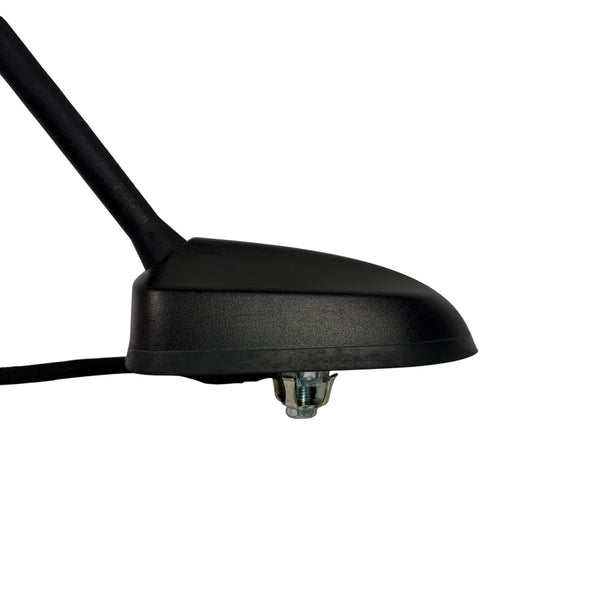
Ford Shark-Fin Roof Antenna Failure: Symptoms & Fix

If your Ford's navigation shows a GPS fault, SiriusXM sits on “acquiring signal,” and AM/FM fades all at once, the shark-fin antenna on the roof is the usual cause. One module up there feeds all of it — GPS, satellite, and radio. Its base seal dries out, water gets in, corrosion attacks the antenna's circuit board, and every signal it carries degrades together.
What are the symptoms of a bad Ford roof antenna?
The tell is that several things fail at the same time. The roof antenna isn't just a fin of plastic — it holds a small electronic board that handles GPS, satellite, and radio reception together, so when it goes, the failures cluster. Watch for these:
- GPS fault or wandering position. The nav screen throws a “no GPS” or “GPS fault” message, or your position drifts and lags behind where you actually are.
- Satellite radio stuck on “acquiring signal.” SiriusXM never locks on, or drops out constantly, even with a clear view of the sky.
- AM/FM reception cuts out. Stations get hissy, weak, or disappear — not one station, but the whole band getting worse.
- A slow battery drain. The antenna module has a powered amplifier; when corrosion shorts it, it can keep drawing current after the car sleeps and pull the battery down overnight.
How do you diagnose a failing shark-fin antenna?
Because there's usually no trouble code to read, you diagnose this one by pattern and by eye. The goal is to confirm the roof module is the common link before you buy anything. Work it in order:
- Check what's failing together. If GPS, satellite, and FM all drop while the screen and speakers still work fine, the shared roof antenna is the suspect — not three separate radios failing at once.
- Look for water and corrosion. Pull the rear edge of the headliner or lift the antenna base and inspect the gasket. A cracked or dried seal, water staining, or green corrosion on the board or connector is the smoking gun.
- Check the coax and pigtail. The antenna feeds the radio through a coax lead and a short pigtail harness. A chafed, unplugged, or corroded connector mimics a dead antenna — reseat and inspect it before condemning the module.
- Test for a parasitic draw. If the battery drains overnight, put a meter in series and watch the current after the modules go to sleep. Anything much above the usual ~50 mA is a clue that a circuit — sometimes the antenna amp — is staying awake.
- Confirm with a known-good unit. Plugging in a tested OEM antenna base and watching GPS, satellite, and radio come back is the final confirmation the roof module was the problem.
What fixes it — and why tested OEM?
The fix is a new antenna base and mast, and on most of these Fords it's a straightforward job — drop the rear headliner edge, unplug the coax and power leads, pull one nut, and swap the base. No programming is required; it's a plug-in part, so signal returns as soon as it's connected. Where it pays to be careful is the part itself. The factory 19G461 antenna is tuned to carry GPS, SiriusXM, and AM/FM together. Plenty of cheap aftermarket fins are AM/FM-only or use a different amplifier — so the radio might come back while GPS and satellite stay dead, and you're back under the headliner a second time. We pull and test OEM Ford antenna bases from real vehicles and confirm the connections before they ship, so navigation and satellite come back the way the factory part delivered them.
Which Fords use this shark-fin antenna?
Fitment is per part number here, so match yours before you order. (You’ll also see it spelled sharkfin, one word — same part.) For the 2016–2019 Ford Escape and Fusion, the shark-fin roof antenna is Ford part number DS7T-19G461-B. For the 2019–2020 Edge and Fusion and the 2019 Escape, the later HJ5T-19G461-B antenna is the correct base. Earlier 2013–2015 Escape and Fusion, and the Focus, Fiesta, and C-Max, use different 19G461 part numbers — the symptoms are the same, but the antenna isn't interchangeable. Check the number printed on your old antenna against our roof antenna collection, or message us with your year and VIN and we'll point you to the exact base.
— Hubes