What Is a Clock Spring? Bad Clockspring Symptoms & Fix


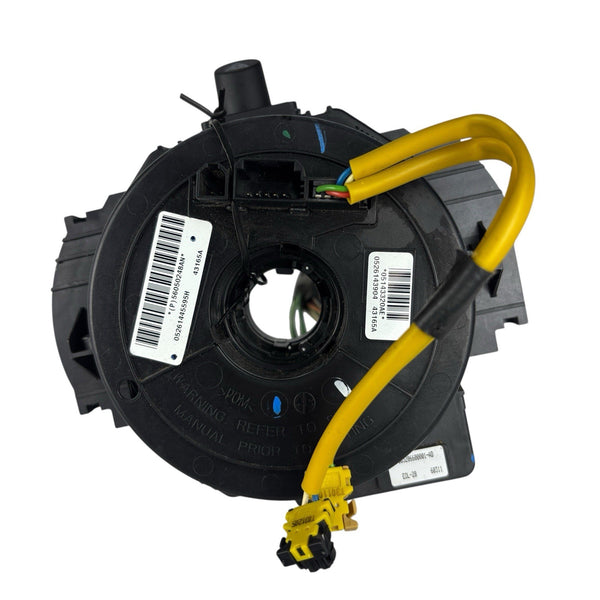
The clock spring (often written clockspring) is the coiled ribbon cable behind your steering wheel that keeps the driver airbag, horn and wheel buttons connected while the wheel turns. If the airbag light comes on and the horn quits at the same time, suspect it first: scan the airbag system for codes, and if they point to the driver airbag circuit, replace the clock spring with the part number that matches your VIN. Until it is fixed, the driver airbag may not deploy in a crash.
If your airbag light came on and your horn stopped working on the same day, you're not dealing with two separate problems. You've got one failing part that's taking everything else down with it — and that part is the clockspring.
Most people never hear the word "clockspring" until something goes wrong. That's how it's supposed to work. But when it fails, it can take out your driver airbag circuit, your horn, your cruise control, your radio buttons, and your phone controls all at once. Understanding what it does makes the failure pattern obvious — and makes shopping for the right replacement a lot simpler.
What a Clockspring Actually Is
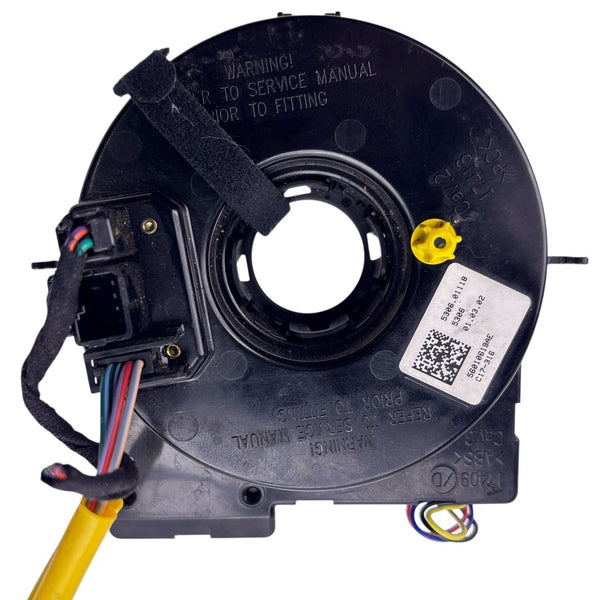
The clockspring — also called a spiral cable or cable reel depending on the manufacturer — is a flat ribbon of electrical wiring coiled inside a plastic housing mounted behind the steering wheel, around the steering column. Its job is to maintain a continuous electrical connection between the fixed wiring in your steering column and the electronics mounted on your rotating steering wheel.
Every time you turn the wheel, that ribbon winds and unwinds inside the housing. The "clockspring" name comes from the way the ribbon coils — same basic idea as a mechanical clock spring.
It's a deceptively simple part doing a job nothing else in the column can do: keep multiple circuits intact through continuous rotation without tangling or breaking. When the ribbon cracks, stretches, or develops an open circuit — which happens after years and millions of steering inputs — the connection fails. And when it fails, everything wired through it fails along with it.
What Systems Run Through the Clockspring
This is why a single clockspring failure looks like a laundry list of electrical problems. Everything that lives on the steering wheel but needs to talk to the rest of the vehicle runs through the clockspring. On most vehicles from the early 2000s forward, that includes the driver airbag, the horn circuit, cruise control, audio and phone controls, and heated steering wheel functions on equipped vehicles.
The airbag circuit is the one that matters most. The SRS — Supplemental Restraint System — module monitors clockspring continuity constantly. The moment it detects an open or intermittent circuit in the airbag loop, it lights the airbag warning and stores a fault. On most vehicles, a stored airbag fault means the airbag is disabled. That's not a cosmetic warning light — it's the safety system telling you it can't do its job.
Why Clocksprings Fail
The ribbon flexes on every steering input for the life of the vehicle, and anything that gets into the housing works against it. The clearest public record of this is a safety recall: in 2016, FCA recalled 2007–2010 Jeep Wrangler JK vehicles because dust could get into the clockspring assembly and make the airbag circuit fail, which could keep the driver's frontal airbag from deploying in a crash. Dealers replaced the clockspring, wheel back cover and column shroud (NHTSA recall 16V-290, Chrysler recall S33).
When the ribbon itself is damaged, clearing the codes won't hold — the fault comes back. Replacing the unit is the fix, not resetting codes and hoping.
Diagnosing a Failing Clockspring
The symptom pattern is the diagnosis. If you're seeing any combination of airbag warning light, non-functional horn, dead or intermittent steering wheel buttons, or cruise control that won't engage — and those symptoms shift or get intermittent as you turn the wheel — the clockspring is the problem. That last part is the clincher: an electrical fault that changes based on steering wheel position is a ribbon fault.
A scan tool will show a B-code related to the airbag circuit or clockspring — something like a driver airbag circuit open on Chrysler products, or a similar SRS code on Ford and GM. These codes confirm what the symptoms already suggest.
Don't sit on an airbag warning. A disabled driver airbag on a daily driver is a real safety issue, not a deferred maintenance item.
Why OEM Matters Here
The clockspring connects directly into the airbag circuit. The ribbon, the contact quality, and the connector tolerances have to match what the SRS module expects — exactly. Aftermarket clocksprings are inconsistent in ways that matter specifically here: incorrect resistance values in the airbag loop can trigger faults even when the physical connection is intact, and low-quality ribbons fail faster than the original.
A tested OEM clockspring from a clean donor vehicle is the right part for this repair. Not because we sell them — because the airbag system is not the place to gamble on whether an off-brand unit was built to spec.
Fitment: Get the Part Number Right Before You Order
Clockspring fitment is more specific than most people expect. Within the same model year, different steering wheel configurations — a heated wheel, extra switch circuits — can require different clockspring designs with different connector layouts and ribbon circuits. A clockspring from a base-trim vehicle may physically install in an upgraded-trim column and still cause airbag faults because the circuit counts don't match.
On the 2008–2016 Chrysler Town & Country and Dodge Grand Caravan, for example, the clock spring for a heated steering wheel is its own part number, 56046392AC.
The right way to confirm fitment is the OEM part number from your specific VIN. Before you buy, also run your VIN through NHTSA's recall lookup — if your vehicle has an open recall on the clockspring, the dealer replaces it free of charge. If you're not sure, message us with your VIN before you order. We'd rather sort it out before the part ships than after.
Frequently Asked Questions
Can I drive with a broken clockspring? Technically yes, but you're operating with a disabled airbag and no horn — both safety concerns. This isn't a repair to put off.
Will the airbag light go off after I replace the clockspring? Not on its own. The SRS fault code needs to be cleared with a scan tool after replacement. A basic OBD-II reader usually won't reach the airbag system — you need a tool with SRS or body code access.
Can I replace a clockspring myself? The physical installation is manageable for a confident DIYer. The steering wheel needs to come off, which requires a steering wheel puller and proper airbag disarm procedure (disconnect the battery and wait the manufacturer's specified time before touching anything in the airbag system). If that part sounds uncertain, have a shop handle it.
Why did my horn and airbag light fail at the same time? Because both circuits run through the clockspring. Simultaneous horn failure and airbag warning is the single most common clockspring presentation — not coincidence, cause and effect.
Do I need to center the steering wheel before installing? Yes, and this step matters. The clockspring has a finite number of rotations in each direction. Install it off-center and it can bind or break the ribbon on a full steering lock. Confirm the wheel is centered and the clockspring is in its neutral (centered) position before mounting.
How do I know which clockspring fits my vehicle? Year, make, model, and trim level — and ideally the OEM part number. Send us your VIN if you're not certain; we'll match the right part before anything ships.
We carry tested OEM clocksprings, pulled from clean donor vehicles and verified before they ship — for example the 2005–2007 Jeep Grand Cherokee and 2006–2008 Commander unit (05143320AE), the 2006–2007 Jeep Liberty (56010619AE), and the 2009–2012 Dodge Ram 1500 with the wiper and turn-signal switch (68050845AB). Browse our clockspring collection for what's on the shelf now, or message us with your VIN if you want confirmation before you order.
— Hubes
Written by
Chris Huber, Owner — Hubes Hub
30 years in OEM auto parts — most of it spent in Michigan. At Hubes Hub I source, test, and ship every OEM part that leaves the shop — and I answer the inbox. If you're working through a tough repair and aren't sure which part you need, message me before you order.
More about the shop →