Ford GEM Module Failure: Symptoms & Diagnosis


If your wipers run when you didn't ask them to, your dome light won't shut off, or the rear defroster quit while the door chime went silent, you're probably not looking at five separate failures. On 1995–2004 Fords, all of those circuits answer to one box: the Generic Electronic Module, or GEM. When it goes, it takes a scattered handful of unrelated features with it.
What the GEM actually controls
The GEM is the body-electronics computer on this generation of Ford. It doesn't touch the engine — that's the PCM. It runs the convenience and interior circuits, and on these trucks that list is long:
- Interior and courtesy lighting, and illuminated entry
- Windshield wipers and washers, including the intermittent delay
- Rear window defroster and its timer
- Warning chimes — door ajar, key-in-ignition, headlamps-on
- Battery saver (killing interior lights after a set time) and accessory delay
- Daytime running lamps, and remote keyless entry functions on equipped vehicles
- On 4x4 trucks with Electronic Shift-On-The-Fly, the transfer case shift logic
That spread is why a failing GEM looks like several broken components at once. One module sits behind all of it.
Where the GEM actually lives — it depends on the model
This is the part that sends people hunting in the wrong place, because the same module family is mounted in two completely different spots:
- F-150, light-duty F-250, Expedition and Navigator — bolted to the back of the interior fuse panel (Ford calls it the Central Junction Box), on the driver's side, above the kick panel.
- Explorer, Mountaineer, Sport Trac, Explorer Sport, Ranger and Mazda B-Series — in the center of the dash, behind and slightly left of the radio and climate controls. You pry the center trim panel and pull the radio to reach it.
If you're on an Explorer or a Ranger and you've been staring at the fuse panel, that's why you haven't found it.
How it shows up
The pattern that points at the GEM is multiple unrelated body circuits misbehaving together, usually intermittently. Common reports on these vehicles:
- Wipers that run continuously, won't shut off, or only work on one speed
- Interior or courtesy lights staying on and draining the battery overnight
- Rear defroster dead, or running when it shouldn't
- Chimes that stopped working, or chime for no reason
- 4x4 that won't shift, or 4x4 lights flashing, on ESOF-equipped trucks
- Symptoms that get noticeably worse during or right after rain
That last one matters more than it looks. Keep reading.
How to diagnose it
Before you condemn the module, do these in order.
1. Check charging system voltage first. The GEM sets B1317 (Battery Voltage High) and B1318 (Battery Voltage Low), and low or spiking system voltage makes body modules behave erratically without being faulty themselves. Worth knowing: these B-codes mean different things depending on which module stored them — the same number from an ABS module is a different fault entirely. Note the module that set the code, not just the code.
2. Scan the body modules, not just the engine. A basic code reader that only pulls P-codes will show you nothing here. You need a scan tool that talks to the body modules to see stored B-codes.
3. Use the GEM's input self-test. Many Fords of this era have a built-in service mode: press and hold the rear-window defrost button, turn the ignition to RUN, then release the button. The module acknowledges, and from there each input you trigger — the wiper stalk, a door switch, a window button — produces a confirmation beep. If a switch produces no beep, the fault is upstream of the GEM (switch or wiring). If every input reports correctly but the output still doesn't work, suspicion moves to the module. The exact procedure varies by model and year — confirm it against the service manual for your vehicle before you read anything into the result.
4. Look for water before you buy anything. See below.
The water leak behind most of these failures
A leaking windshield is the most commonly reported cause of GEM failure across this whole family, and it is not just a truck problem. On the F-150, Expedition and Navigator the water runs down onto the Central Junction Box the module is bolted to. On the Explorer and Mountaineer the same leak finds the center-dash module instead — owners of 1998–2001 Explorers and Mountaineers report it as often as F-150 owners do. Either way, the corrosion that follows produces exactly the symptoms above, which is why the trouble tracks the weather. Ford issued service guidance on windshield sealer voids on 1995–99 F-150s.
The practical consequence: find and fix the leak before you install a replacement module, or you will kill the new one too. Get to whichever location your vehicle uses — kick panel on the trucks, center trim on the Explorer and Ranger family — and look for staining, green corrosion on the connector pins, or standing water. If the fuse box itself is corroded, replacing only the GEM can leave you chasing the same faults, because the corrosion is in the junction box pins.
Which GEM you need — and why the part number matters
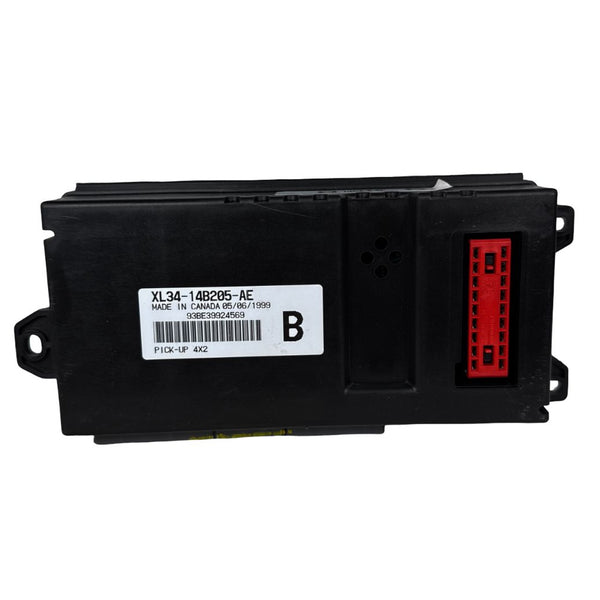
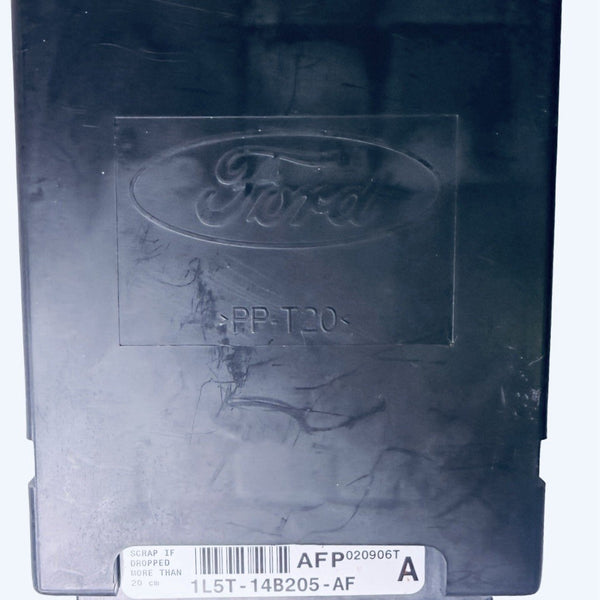
Every GEM in this family shares the Ford basic number 14B205. What separates them is the prefix and the suffix, and this is where buyers get burned.
On the F-150 line, the suffix's first letter tracks the truck's configuration
— 4x2 versus 4x4/ESOF, power group — and the second letter is the revision
level, which generally does interchange. So F75B-14B205-MB and
F75B-14B205-MA are revisions of the same configuration, while
F75B-14B205-ND is a different build.
Do not carry that letter map across to another platform. On the Explorer and Ranger lines the same letters mean different things by generation. We treat configuration letters as platform-specific and match against attested interchange sets for that exact part — never by letter arithmetic. If you take one thing from this section: match your existing part number, and treat a different first letter as a different part until something authoritative says otherwise.
One more generation trap: 2001 and later Rangers moved 4x4 shift control out of the GEM into a separate transfer case control module. If you have a 2001-up Ranger with a 4x4 complaint, the GEM may not be your part at all.
Fitment
The GEMs we stock cover these vehicles:
- Ford Ranger and Mazda B3000 / B4000, 1995–2003, and Mazda B2300, 1995–1997
- Ford Explorer, 1995–2001, Mercury Mountaineer, 1998–2001, and the Explorer Sport and Sport Trac, 2001–2003
- Ford F-150, 1997–2003, and the 2004 F-150 Heritage; light-duty F-250, 1997–1999
- Ford Expedition and Lincoln Navigator, 1997–1999
- Ford Mustang, 2000–2004
Because configuration is encoded in the suffix, the year and model alone are not enough — match your existing part number, and tell us your 4x2/4x4 and option setup if you're unsure. Browse what's on the shelf in Generic Electronic Modules (GEM). If the diagnosis points at the body computer on a newer Ford instead, that's a BCM, which we cover separately.
Why a tested OEM module
There is no meaningful aftermarket for these. A GEM is a Ford module or it is a Ford module someone else has resold. What varies is whether anyone checked it before it shipped. Ours are pulled, bench-powered and function-checked, and listed with the exact part number off the label — not a superseded number we assumed would cross over.
A GEM generally does not require dealer programming the way a BCM or immobilizer does, but configuration must match. If you want the wider picture on which modules need programming and which don't, we wrote that up in Do BCMs, Clusters & Immobilizers Need Programming?
Frequently asked questions
What does a GEM module do on a Ford?
It's the body-electronics computer. It controls interior lighting, wipers and washers, the
rear defroster, warning chimes, battery saver and accessory delay, daytime running lamps, and
on 4x4-equipped trucks the electronic shift-on-the-fly transfer case logic. It does not
control the engine.
What are the symptoms of a bad GEM module?
Several unrelated body circuits failing at once, usually intermittently: wipers running on
their own or stuck on one speed, interior lights that won't go out, a dead rear defroster,
missing or false chimes, and 4x4 shift faults. Symptoms that worsen in wet weather are a
strong clue.
Where is the GEM module located?
It depends on the model. On the F-150, light-duty F-250, Expedition and Navigator it is bolted to
the back of the interior fuse panel (the Central Junction Box) on the driver's side, above the kick
panel. On the Explorer, Mountaineer, Sport Trac, Explorer Sport, Ranger and Mazda B-Series it sits
in the center of the dash, behind and slightly left of the radio.
Can water damage a GEM module?
Yes, and it's a well-documented cause on 1997–2003 F-150s. A leaking windshield or cowl
seam drips onto the Central Junction Box the module is mounted to. Fix the leak before
installing a replacement, or the new module will fail the same way.
Does a replacement GEM need to be programmed?
A GEM generally doesn't require the VIN programming that a BCM or immobilizer does, but the
replacement's configuration must match your vehicle — drivetrain and option group are
encoded in the part number suffix.
Will any 14B205 module fit my truck?
No. 14B205 is the basic number shared across the family; the prefix and suffix identify the
platform, model year range, and configuration. Match your existing part number.
My 2002 Ranger won't shift into 4x4 — is that the GEM?
Probably not. 2001 and later Rangers use a separate transfer case control module for 4x4 shift
control, so a 4x4-only complaint on those trucks points elsewhere.
— Hubes
Written by
Chris Huber, Owner — Hubes Hub
30 years in OEM auto parts — most of it spent in Michigan. At Hubes Hub I source, test, and ship every OEM part that leaves the shop — and I answer the inbox. If you're working through a tough repair and aren't sure which part you need, message me before you order.
More about the shop →