Climate Control Head Failure - Symptoms & Diagnosis

If the buttons on your climate control do nothing, the display is blank or flickering, or the blower is stuck on one speed no matter what you press, the fault is usually the control head itself — the panel in the dash. That's a different part, and a different repair, from the actuator that clicks behind the dash. Sorting out which one you have takes about five minutes and saves you buying the wrong thing.
Control head or actuator? Start here
These two get confused constantly, and they are not the same part.
It's probably the control head if: buttons or knobs don't respond, or respond intermittently; the display is blank, dim, flickering, or missing segments; the fan is stuck on one speed or won't turn off; the backlight is out; tapping the panel makes it work for a moment.
It's probably a blend door actuator if: you hear clicking, ticking, or ratcheting from behind the dash — typically for several seconds after startup or right after you change the temperature; you get heat on one side and cold on the other; the temperature won't follow the setting even though the panel responds normally. That noise is stripped plastic gears inside the actuator, and no control head will fix it.
The short version: if the panel doesn't respond, look at the panel. If the panel responds but the air doesn't do what it's told, look downstream — actuator, blower motor resistor, or the doors themselves.
How it shows up
The control-head complaints we see most often on these vehicles:
- Blank display, or a display missing segments and hard to read at night
- Backlighting dead, so the panel is invisible after dark but still works
- One or more buttons that need a hard press, or don't work at all
- Temperature setting that jumps several degrees per press, or scrolls on its own
- Rear controls dead while the front still works, on dual-zone systems
- Printed button graphics worn away, which is cosmetic but is why plenty of these get replaced
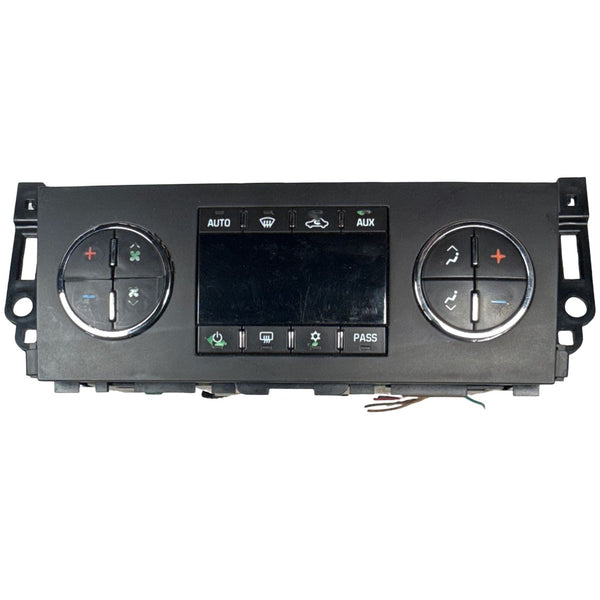
On 2007–2014 GM trucks and SUVs, dead or intermittent displays are commonly traced to cracked solder joints on the board rather than anything wrong with the rest of the system.
How to diagnose it
1. Check fuses and the blower first. A dead panel with a dead blower is more likely a supply problem than a failed head. Confirm the panel is getting power before you condemn it.
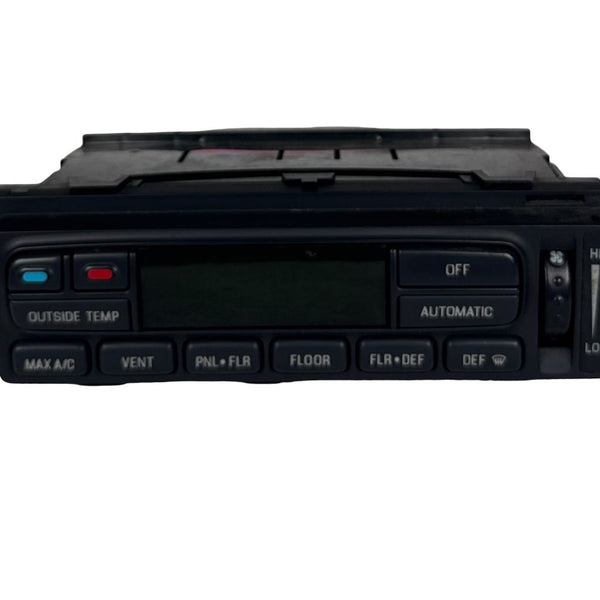
2. On Ford's electronic automatic systems, run the EATC self-test. Ford's Electronic Automatic Temperature Control heads have a built-in test that reads out stored climate DTCs without a scan tool:
- Press and hold OFF and FLOOR together, then press AUTO within two seconds.
- The display shows a pulse tracer circling the center of the window. The test can run up to 30 seconds, then reports any stored codes.
- Cabin temperature needs to be roughly 40–90 °F when you run it. Outside that range you'll get false in-vehicle temperature sensor codes.
- Exit with the blue (cooler) button to keep intermittent codes stored, or
with DEFROST to clear them — the display shows
888for a second when it clears.
One honest limitation: a clean self-test doesn't prove everything works. Several system outputs report nothing back to the control head, so they can fail silently. Use the test to find faults, not to rule them out. This test applies to the automatic (EATC) systems — manual A/C-heater panels don't have it.
3. Scan the HVAC module. On GM and later Fords, a scan tool that talks to the body/HVAC module will pull climate-specific codes that a generic engine-only reader won't see. Actuator faults usually announce themselves here, which is the fastest way to separate actuator from head.
4. Check the backlight separately. If every function works and only the lighting is dead, that's the panel's internal lighting, not a system fault — and it's a control head replacement, not a diagnostic rabbit hole.
The fix, and what to match
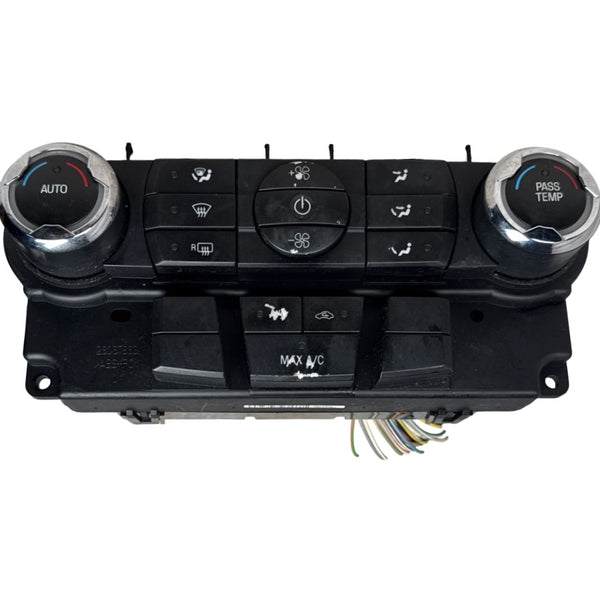
Climate control heads are option-coded. Dual-zone versus single-zone, manual versus automatic, heated seat buttons integrated into the panel, rear-climate controls, and even the finish differ across trims of the same truck in the same year. Two of our own Fusion listings differ only by whether the panel carries heated-seat switches.
So match the part number off the back of your existing panel. Year, make and model alone will not get you there. Pull the panel, photograph the label, and match the number — that is the whole trick, and we wrote up how to read those numbers in Finding the Right Part Number.
These are OEM electronics with no real aftermarket equivalent worth having. Ours are pulled, powered up and function-checked — buttons, display segments, backlight — and listed with the exact number off the label. Browse Climate Control for what's on the shelf.
Fitment
The control heads we stock cover:
- Ford F-150, 1999–2008
- Ford F-150 Heritage, 2004
- Ford Expedition, 1999–2002 and 2012–2014
- Lincoln Navigator, 1999–2002
- Ford Fusion and Lincoln MKZ, 2010–2012
- Mercury Milan, 2010–2011
- Lincoln Mark LT, 2008
- Chevy Silverado 1500 HD and GMC Sierra 1500 HD, 2003 and 2005–2006
- Chevy Silverado 1500 and GMC Sierra 1500, 2007–2011
- Chevy Tahoe, Chevy Suburban 1500, GMC Yukon and GMC Yukon XL 1500, 2007–2011
Several of these are option-coded rather than year-coded — the F-150 and Mark LT panels we carry are for automatic dual-zone with factory heated seats, and the Fusion, Milan and MKZ panels split on whether the car has heated-seat controls. The year and model get you close; the number on the back of the panel is what actually decides it.
Stock moves, so treat this as the shape of the range rather than a promise for a specific truck — check the collection, or send us your part number and we'll tell you straight whether we have it.
Frequently asked questions
What are the symptoms of a bad climate control head?
Unresponsive or intermittent buttons and knobs, a blank or flickering display, missing display
segments, dead backlighting, or a blower stuck on one speed. If the panel itself won't respond
or won't display, the panel is the suspect.
Is clicking behind the dash a bad climate control head?
No. Clicking or ratcheting behind the dash — usually for several seconds after startup or
after changing the temperature — is a blend door actuator with stripped gears. Replacing
the control head will not fix it.
How do I run the Ford EATC self-test?
Hold OFF and FLOOR together, then press AUTO within two seconds. The display shows a pulse
tracer and the test runs up to 30 seconds. Exit with the blue cooler button to retain codes, or
DEFROST to clear them. Cabin temperature should be between about 40 and 90 °F or you'll get
false sensor codes.
Why is my climate control display blank but the buttons still work?
That points at the panel's own display or backlighting rather than the climate system. On
2007–2014 GM trucks it's commonly traced to cracked solder joints on the control head's
board.
Will a climate control panel from the same year fit my truck?
Not necessarily. These are option-coded — single versus dual zone, manual versus
automatic, integrated heated-seat switches and rear controls all change the part. Match the
number on the back of your existing panel.
Does a replacement climate control head need programming?
On most of the vehicles we stock these for it's a plug-in swap, but some later systems expect
the module to be recognized by the vehicle. Match the exact part number and configuration and
you avoid the question entirely.
— Hubes