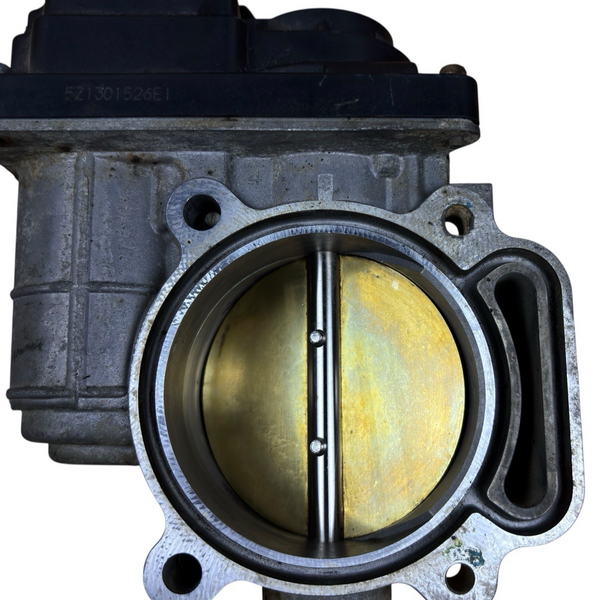
LaCrosse, Lucerne & Grand Prix 3.8L Throttle Body: P2135


On the 3.8L Series III V6 (L26 and supercharged L32) in the Pontiac Grand Prix, Buick LaCrosse and Buick Lucerne, the throttle body is drive-by-wire with two built-in position sensors and no separate IAC motor, so when it fails you get a Reduced Engine Power message and code P2135, which means those two sensors disagree. Cleaning won't fix a sensor correlation fault: check the connector and wiring, then replace the throttle body and let the PCM relearn it. If the code is P2138 instead, a different sensor pair is disagreeing, so check the accelerator pedal assembly as well.
Which cars have this throttle body
GM's 3.8L Series III V6 brought electronic throttle control to the 3800 for 2004. It went into the 2004–2008 Pontiac Grand Prix, the Buick LaCrosse from 2005 and the 2006–2008 Buick Lucerne (Brake & Front End). The supercharged L32 version went into the Grand Prix GT and GTP.
Our tested OEM unit, GM 12607894, fits the 2005–2009 Buick LaCrosse and Allure 3.8L, the 2006–2008 Buick Lucerne 3.8L and the 2005–2008 Pontiac Grand Prix 3.8L. If your 3.8L has a throttle cable, it is the earlier Series II, and that one has its own post: GM 3800 Series II throttle body.
How it works, and why it fails
There is no cable between the pedal and the throttle. The pedal assembly sends its position to the PCM, and an electric motor in the throttle body moves the throttle plate. The PCM also sets idle by moving the throttle plate itself, so there is no separate IAC motor to replace.
Two position sensors inside the throttle body report the plate's position at the same time, and the PCM compares them constantly. When they disagree, it sets P2135 and cuts power to protect the drivetrain. Worn sensor tracks, a loose or corroded connector, and a wiring fault can all cause that disagreement.
The symptoms
- A Reduced Engine Power message, often on the highway or under load, and intermittent at first
- Owners also report "Starting disabled due to electronic throttle control" and the traction control light coming on at the same time
- Sudden loss of speed, hesitation, or an idle that surges or hangs
- Codes: P2135 (throttle position sensor A/B correlation) is the classic one; P0121–P0123 can appear alongside it
How to diagnose it
- Read the exact code. P2135 points at the throttle body's sensor pair. P2138 points at a different pair (D/E), so look at the accelerator pedal assembly and its wiring too. Reduced Engine Power is a protective mode with more than one cause, not a part number.
- Check the connector and harness at the throttle body for corrosion, a loose lock or chafed wires before replacing anything.
- Watch both sensor signals with a scan tool while you open the throttle slowly. They should move together with no dropouts.
- Don't stop at cleaning. Carbon can roughen the idle, but it does not cause a correlation code.
The fix
Replace the throttle body with the right part number, fit a new gasket, clear the codes, and let the PCM learn the new unit's closed-throttle position. GM service information has the procedure for your year, and a scan tool can run it. Then confirm with the scan tool that both sensors track together before you call it done.
Our 12607894 is a used OEM GM throttle body, tested before it ships. See everything we carry in our throttle body collection.
Frequently asked questions
What does P2135 mean on a LaCrosse, Lucerne or Grand Prix? P2135 is "Throttle/Pedal Position Sensor/Switch A/B Voltage Correlation": the two position sensors disagree. On these cars it points at the throttle body or its wiring, and the PCM cuts power to protect you.
P2135 or P2138: is it the throttle body or the gas pedal? P2135 reports the A/B sensor pair and P2138 the D/E pair. Owners have reported Reduced Engine Power fixed by a new accelerator pedal as well as by a throttle body, so read the exact code and check the pedal and wiring before you buy.
Will cleaning fix Reduced Engine Power? Not if the cause is a sensor correlation code. Cleaning removes carbon from the plate and bore. It does not repair a worn sensor or a broken connection, and unplugging the harness to clean can make an intermittent fault go quiet for a while.
Is there a recall on the 3.8L throttle body for these cars? Not that we found. NHTSA's recall records for the 2004–2008 Grand Prix, 2005–2009 LaCrosse and 2006–2008 Lucerne include no throttle body recall. The one accelerator-control recall, 05V046000, replaced the accelerator pedal on certain 2004 Grand Prix because a pedal return spring could fail in extreme cold.
Is the supercharged throttle body the same part? Don't assume it is. The supercharged L32 (Grand Prix GT and GTP) differs from the L26. Match the part number on your old throttle body; ours is GM 12607894.
Can I drive with Reduced Engine Power? Only far enough to get somewhere safe. The PCM limits throttle, and owners report speeds dropping suddenly in traffic. Get it diagnosed before you drive it again.
Not sure which part your car takes? Message us with the year, model and engine and we'll match it.
— Hubes
Written by
Chris Huber, Owner — Hubes Hub
30 years in OEM auto parts — most of it spent in Michigan. At Hubes Hub I source, test, and ship every OEM part that leaves the shop — and I answer the inbox. If you're working through a tough repair and aren't sure which part you need, message me before you order.
More about the shop →